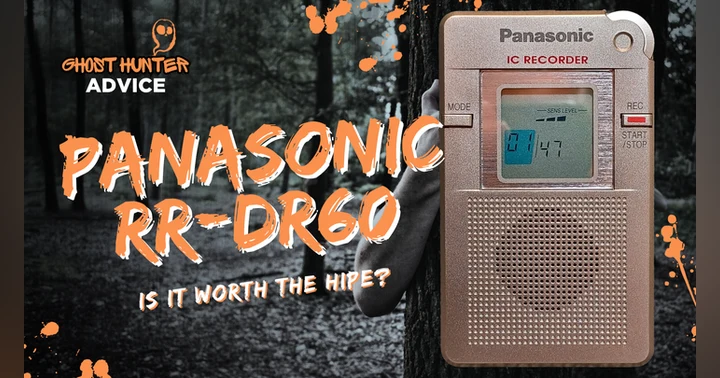
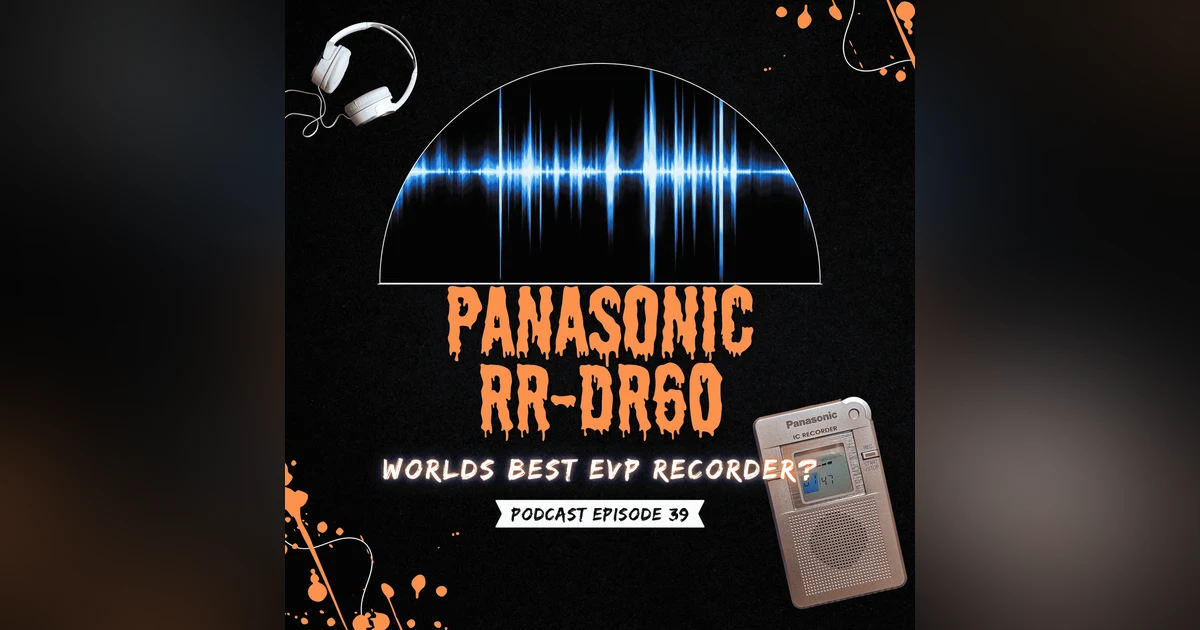
Panasonic RR-DR60: Is it the Best EVP Recorder?


 Apple Podcasts Apple Podcasts
  Spotify Spotify
  Castro Castro
  RSS Feed RSS Feed
  Amazon Music Amazon Music
  Podcast Addict Podcast Addict
  Audacy Audacy
  Audible Audible
  Castbox Castbox
  Deezer Deezer
  Fountain Fountain
  Goodpods Goodpods
  iHeartRadio iHeartRadio
  JioSaavn JioSaavn
  Overcast Overcast
  Pandora Pandora
  PocketCasts PocketCasts
 Is the Panasonic DR60 the best EVP recorder ever made? I take a look at the specs, check out the tests, and let you know if it actually works.
You'll want to check out this episode before you drop $1000 plus on this EVP recorder.
Links to the show:
- Website: https://www.ghosthunteradvice.com/
- Instagram: https://www.instagram.com/ghosthunteradvice/
- Facebook: https://www.facebook.com/ghosthunteradvice
- FB Group: https://www.facebook.com/search/top?q=ghost%20hunter%20advice%20group
- Email questions to ghosthunteradvice@gmail.com
Episode Resources
- Check out the blog post at https://www.ghosthunteradvice.com/blog/panasonicrr-dr60/
- Link to CFI video: https://www.youtube.com/watch?v=nqxlvUoEgP4
- Link to Dr. John P. Costella: https://johncostella.com/ghosts/
Building you equipment stock pile, or just getting started check out my Equipmant page for affilate links to recomended gear. https://www.ghosthunteradvice.com/equipment/
Intro by Will Rice
00:00 - Untitled
00:14 - Is the Panasonic DR-60 the Best for EVP Recording?
01:00 - Panasonic RR-DR60 Deep Dive
03:32 - Understanding Sound Quality and Sample Rates
07:06 - How Low-Bitrate Recorders Alter and Reconstruct Sound
10:02 - Debunking the Panasonic urban-legend: software fixes and the QR series
13:17 - Further resources — recommended video and studies on the DR-60
The Panasonic Dr. 60.It is probably one of the most famous devices in ghost hunting and it keeps popping up every so often where I see new investigators experimenting with it.But is this really the end all, be all, number one device for EVP recording?We're going to talk about that today.Advice from the pros.Stories from the haunted.You're listening to the Ghost Hunter Advice podcast.Welcome back to Ghost Hunter Advice.I'm your host, Tanner.And today's episode, we're getting into the Panasonic RR Dr. 60.This is a pretty popular unit, and the other day I was looking around in some of the ghost hunting groups on Facebook and I noticed that someone purchased that they had just bought two of them.This is one of those pieces of tech that I honestly thought had been completely debunked a few years ago.My day job, I work in audio.I do a lot of audio production outside of this podcast.I do audiobooks and I do some voice acting.So this is my wheelhouse in my world.And I wanted to take a minute and talk about this because these devices are going for thousands of dollars on ebay and on different platforms.I think when you look at ordering equipment and you're using equipment, whether you're new or you're seasoned, it's really important to understand the basics and understand the how and the why of how these things work.So the Dr. 60, if you're not familiar with this device, it is the recorder that's actually in the artwork for today's episode, if you want to take a look at it.This was one of the very first consumer grade digital recorders to hit the market.And I believe it hit the market in 1998.It was only out for about a year.It was replaced in 1999.And there was this big urban legend that popped up around this device that Panasonic knew that it was making contact with the dead and picking up EVPs.So they discontinued it and swept it under the rug and didn't want to talk about it.And so that urban legend grew for a while and these devices got harder and harder to find and more recorders came out, better recorders came out, and I thought it was done.But every so often I see people talking about this and it gets this whole new wave of folks excited about this particular recorder.So what exactly does it do?The Dr. 60 has been known for getting EVPs everywhere.They sound like these weird demonic growls that may or may not be an answer to a question.Sometimes if you just let it run for a little Bit in between your questions, it sounds like there's a group of people chattering in the background and there's just, there's a lot of weird clicks, a lot of background noise.It generates a lot of white noise.And people say that Those are legitimate EVPs and spiritual voices being captured.But there's a lot going on with that recorder.And to really understand what's going on there, we're going to have to get into some of the nerdy stuff and talk about sound quality.So when we're recording sounds, there's one specific thing that I look for in my audio equipment and that is the sample rate.I'm recording a sample rate of 44.1 kilohertz.The sample rate is the number of times per second that the sound is sampled.So at this 44.1, the recorder is sampling and marking sounds 44,100 times every single second.The Dr.60.Again, this was an early technology and this was one of the first attempts at a consumer grade digital recorder.The sample rate had to be set ultra low to be able to get the amount of time which they were shooting for an hour on this recorder, to be able to record that much time on this device.And they weren't super worried about quality.They didn't worry about anything except the notes and what the person speaking into the recorder was saying being picked up by the recorder.Because it was originally just a dictation device.It was just for taking quick notes for businessmen, journalists, and people who were going through a crapload of cassette tapes with those little micro recorders.The sample rate was set at 6000 Hz or 6 kg.That means that it sampled 6000 times a second.It's not a lot.So again, this podcast is 44,100 times a second.And this is CD quality.This is a high fidelity recording.What I'm doing and what's going on in the room is being picked up by the microphone.At 6 kilohertz, you're missing a lot of stuff.So to the human audible range is between 20 and 20,000 hertz.So 20 hertz to 20 kilohertz.When you're recording sound, you have to have a sample rate that is double the frequency that you are recording.So to get the entire audible range of what we can hear as humans, you have to have at least a 40kHz sample rate or 40,000 sample rate.At 6kHz, you're only recording frequencies up to 3000Hz, which is not a lot.It leaves a lot out of the recording and some weird stuff starts to happen.There's this thing called alising, and I think I'm saying that right, basically it's where a sound occurs outside of the range of the recorder.Today's stuff that happens outside of the human audible range, it makes it past the, the filter on the recording device and it gets bumped back into the audible range.I think usually it sits at somewhere around 14 hertz.If it's like a 30,000, excuse me, if it's a 30 kilohertz sound, 10 kilohertz outside of the human audible range, it bumps it down to like 14 and it makes a really weird metallic noise.And there was some of that happening on the recorder, but other than that super low bit rate to record sound digitally onto the memory cards back then, excuse me, memory banks, because memory cards I don't think were a thing yet.It was internal flash memory.As it was recording, it didn't actually save the sound that the microphone was hearing.So it had a stored memory bank of, I can't remember how many.It's not very many waveforms.And that's the.If you're looking at Audacity and you are reviewing EVPs, the waveform is what you see.It's the visual representation of the sound.When you change that, it changes the sound.And instead of recording the exact wave pad or waveform onto the device, which is what's happening right now with the recorder I'm using, it had a stored memory bank of a few recognizable waveforms.And it would compress whatever was being heard into a waveform that matched the nearest one on its bank.And then that was what was saved into the recorder.It also saved at one second intervals, even if there was not a full second of audio.And it made stuff up again to fill out that waveform and save that one second of audio.So what you got was a recording that didn't actually sound like the original voice that was being recorded or atmosphere that was being recorded.It actually made some stuff up, but it got the gist of what was being said for the note takers, which was the point of the device.Now what happened was when all of that stuff was being compressed during the process, it started making up new sounds.The argument that was being used, the voices being heard on the tape were actual EVPs, was that these sounds were being bumped down into the audible range of the recorder and that's where the EVPs were coming from, and that they were a physical artifact being recorded in the environment.It was an environmental Artifact.That's the best way to say that.So this got the attention of Dr. John P. Castella.He is a particle physicist, has multiple PhDs, and he went on a ghost hunt, a little ghost tour where they had these devices.And he was really interested on what was happening.He conducted a study where he had a few ideas of what was going on, a couple hypothesis that he wanted to test.And he got to use two of the devices side by side in the same environment, recording the exact same thing.When those recorders finished on playback, the recordings were totally different.So what that told Dr. Costella was that it is most likely an internal software issue with that recorder.And after testing over and over and over, I feel comfortable saying These are not EVPs.These are not the voices of ghosts or extra dimensional beings.This is a software glitch.As for the urban legend about Panasonic knowing that this was a device that could be used to communicate with the dead and discontinuing it and trying to bury was just a faulty product, the next year, in 1999, they came out with the QR series where they addressed these issues with how sound was being saved on the memory file.And when they fixed the software issue, it fixed the recorders.The QR80, I believe, is the one that replaced the Dr.60.And it does still have the problems with the super low bit rate.So keep that in mind.But as far as the Dr. 60 goes, this is a software glitch because again, this was a new technology and they were playing with different ways to get the job done with the limited technology they had in the 1990s going into the early 2000s.But I do get a couple of people that bring this up every so often, other ghost hunters that swear by them or want to experiment with them.I would not spend a thousand dollars or $3,000 on one of these devices.It's a cool party trick.It's something that's interesting.It is absolutely spooky and super disturbing to hear some of these recordings, especially the growls that come through.But again, it is just a software issue.It's not legitimate EVPs.So if you're looking for a good EVP device and you're like, all right, I'm gonna put a lot of power behind this.Don't worry about spending $1,000 on a Dr.60.Get the Zoom H1E for $108, it is a much better recorder.And there's another argument that I forgot to cover and it's that these old recorders did not have filters and they didn't, they didn't have settings that blocked background noise and just focused on the voice.On these higher end zoom recorders and the Olympus series that I linked to over on the equipment page, which is ghostunderadvice.com equipment, they have settings where you can turn those off and I do recommend turning those off during EVP sessions so that you don't have the chance of bumping stuff off of the audio.But that's all you have to do, just turn those filters off, get a new high fidelity recorder that's actually recording what's being heard in the environment and yeah, run your EVP sessions.You can find links to recorders and other ghost hunting tools.They've been categorized and inside the categories they're listed least expensive to most expensive.So if you are outfitting yourself to just start or you are looking to expand your collection of equipment and get more into ghost hunting, check that out over at ghost hunter advice.com equipment if you have questions, send those in ghost hunter advice.com voicemail if you want to leave a voicemail or email me at ghost hunter advicemail.com all of the equipment listed on the websites, those are affiliate links, so I do get a small commission from each sale there.If you are buying equipment, that's just a quick way to support the show without actually having to spend anything extra.So.All right, that's all I got for today.There was a great video that was a massive help from Kenny Biddle at the center for Inquiry Video cfi.I've linked to that over on the blog page.He does about 30 minutes where he goes in depth on this device and breaks it down.Just does an absolutely amazing job.I've also got links to Dr. John P. Castella's study on the Dr. 60.If you actually want to go through, look at the controls and look at the experiments he ran there.Anyway, that's all I've got for now.Keep those questions coming in and stay safe out there.Boom.Scared you.